La démo fonctionne toujours. Un agent lit un ticket, rédige une réponse, traite le remboursement et boucle la boucle pendant que la salle acquiesce. Puis il passe en production, rencontre les mille cas suivants, et commence à rembourser des commandes qui n'ont jamais existé.
Rien dans la démo n'était faux. Ce qui manquait, c'est tout ce qui rend les mille cas suivants gérables — la partie que personne ne filme. Les agents IA autonomes ne sont pas difficiles à démarrer. Ils sont difficiles à maintenir honnêtes.
Une démo n'est pas un système
Un modèle capable d'appeler un outil est une capacité. Un système qui appelle le bon outil, au bon moment, sur le bon état, et peut l'expliquer après coup — c'est de l'infrastructure. La distance entre les deux n'est pas un meilleur prompt.
Dans une démo, l'agent s'exécute une fois, sous surveillance, sur un chemin idéal. En production, il s'exécute dix mille fois, sans surveillance, sur un état qui dérive entre le moment où il lit et le moment où il agit. La mémoire est périmée ou absente. Une étape rejouée facture deux fois. Un appel d'outil qui aurait dû être refusé passe, parce que rien ne gardait la porte.
Ce ne sont pas des défaillances du modèle. Ce sont les défaillances qu'un runtime est censé absorber. Les traiter comme des problèmes de prompt, c'est ce qui pousse les équipes à passer un trimestre à reformuler des instructions sans jamais pouvoir répondre à la seule question qui compte lors d'un incident : qu'a fait l'agent, et sur quelle base.
La boucle que les agents IA autonomes exécutent réellement
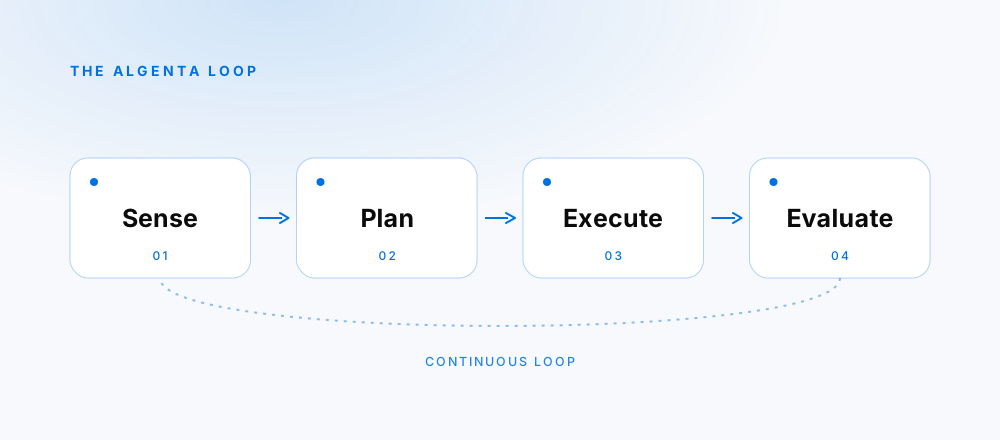
Algenta est le runtime déterministe sur lequel les agents IA agissent, construit autour d'une boucle unique que chaque agent exécute, que ses auteurs l'aient nommée ou non. Rendre cette boucle explicite, c'est l'essentiel du travail.
- Percevoir — lire l'état actuel du monde : entrées, mémoire récupérée, valeurs en direct dont dépend la décision.
- Planifier — décider de la prochaine action, ou des suivantes, en fonction de cet état et de l'objectif.
- Exécuter — agir via des outils gouvernés, où chaque appel est vérifié contre la politique avant de toucher quoi que ce soit de réel.
- Évaluer — juger ce qui s'est passé par rapport aux attentes, et réinjecter ce jugement dans la mémoire et le plan suivant.
Percevoir, planifier, exécuter, évaluer. Les étapes sont évidentes ; la discipline consiste à refuser de sauter la dernière. La plupart des frameworks d'agents s'arrêtent à l'exécution — c'est précisément pourquoi ils font de bonnes démos et vieillissent mal : ils agissent sans jamais être notés, si bien que l'erreur se compose en silence au lieu d'être interceptée au tour où elle survient.
Autour de la boucle se trouvent des primitives partagées que l'ensemble du runtime traite comme des éléments de premier ordre, non comme des ajouts : la mémoire que l'agent lit et écrit, les outils par lesquels il agit, la politique qui gouverne chaque action, les traces qui enregistrent ce qui s'est produit, et les évaluations qui décident si c'était juste. Chaque étape de la boucle touche chaque primitive. La mémoire alimente Percevoir et est mise à jour par Évaluer. La politique conditionne Exécuter. Les traces capturent les quatre étapes pour qu'Évaluer ait quelque chose d'honnête à noter.
Un agent qu'on ne peut pas noter n'est pas autonome. Il est sans surveillance.
Pourquoi les primitives ingrates sont le produit
Mémoire, politique, traces, évaluations. Rien de tout cela ne se photographie bien. Tout cela est ce qui sépare un agent qui fonctionne dans la salle d'un agent qui fonctionne dans le monde.
La mémoire permet à un agent d'agir sur ce qu'il savait une seconde auparavant plutôt que de redécouvrir le monde à chaque appel — et un runtime doit tracer la frontière entre la connaissance durable et l'espace de travail d'une seule exécution, car les confondre, c'est laisser un agent commencer à faire confiance à ses propres hallucinations. La politique est la différence entre un outil qu'un agent peut appeler et un outil qu'il est autorisé à appeler maintenant, compte tenu de qui il représente et de ce qu'il a déjà fait cette heure-ci. Les traces transforment « l'agent a fait quelque chose d'étrange » en une décision précise, sur une entrée précise, avec le contexte précis qu'il avait — la différence entre déboguer et deviner.
Les évaluations sont la primitive que les équipes découvrent en dernier et dont elles ont besoin en premier. Sans elles, « l'agent fonctionne » signifie « personne ne s'est encore plaint bruyamment ». Avec elles, chaque exécution est notée — par rapport à une vérité terrain là où elle existe, par rapport à des règles et des critères là où elle n'existe pas — et une régression apparaît comme un nombre qui a bougé, sur le changement qui l'a fait bouger, avant d'atteindre un client.
L'orchestration est un moyen, pas une fin
L'orchestration d'agents concentre l'essentiel de l'attention — le graphe d'étapes, les nouvelles tentatives, les transferts entre agents et sous-agents. C'est important. Mais l'orchestration sans gouvernance n'est qu'un moyen plus rapide de faire la mauvaise chose à grande échelle, et l'orchestration sans évaluation est un moyen plus rapide de le faire sans s'en apercevoir.
Algenta traite l'orchestration comme une couche d'un environnement de runtime d'agents IA, non comme sa totalité. Un plan peut se ramifier, appeler d'autres agents, exécuter une simulation pour tester une action avant de la valider, et attendre un humain quand la politique l'exige — et chacun de ces mouvements atterrit dans la même trace, gouverné par la même politique, noté par les mêmes évaluations. L'orchestration décide de ce qui se passe ensuite. Le runtime décide si c'est autorisé, et si c'était juste.
C'est la promesse discrète derrière une plateforme de runtime d'agents IA : que percevoir, planifier, agir et juger ne devraient pas être réassemblés à la main par chaque équipe qui veut un agent en production. Ce sont des infrastructures. On devrait pouvoir les supposer acquises comme on suppose qu'une base de données est durable.
Ce qui change quand la boucle est fermée
Quand la boucle complète s'exécute — quand l'évaluation n'est pas une réflexion après coup mais le quatrième temps de chaque cycle — la nature du travail change. Les agents IA autonomes cessent d'être quelque chose qu'on lance en espérant le meilleur, et deviennent quelque chose qu'on peut opérer : observer, borner, corriger, et faire confiance dans des limites définies.
C'est la frontière entre une démo et une intelligence opérationnelle. Une démo vous demande de croire. Un runtime vous permet de vérifier. Les équipes qui feront tourner des agents IA autonomes à grande échelle sont celles qui décident tôt que les primitives ingrates sont le produit — et qu'un agent qui ne peut pas être noté n'a pas le droit d'agir sans surveillance.