Une cotation arrive, vieillit et disparaît. Le temps qu'un modèle finisse de la raisonner, le carnet a bougé, le spread s'est élargi, et l'ordre recommandé est un pari sur un marché qui n'existe plus. La plupart des systèmes de trading ne se trompent pas parce que leur logique est mauvaise. Ils se trompent parce qu'ils ont répondu trop tard.
Decimas est un logiciel de trading algorithmique construit autour de ce seul problème. C'est un runtime de trading déterministe — un environnement pour observer les marchés, modéliser ce qui vient ensuite, et acheminer les ordres dans le temps dont vous disposez réellement. Le travail relève de l'infrastructure, non de la prophétie. Il ne promet pas de rendements ; il promet que la décision que vous envoyez est celle que vous avez raisonnée.
Un ordre est une décision sous contrainte de temps
La contrainte déterminante de toute plateforme de trading algorithmique n'est pas la sophistication de la stratégie. C'est le temps qui s'écoule entre un signal et l'action qu'il justifie. Cet intervalle est un budget, et chaque composant y puise : ingestion du marché, lecture des features, simulation, contrôle de politique, ordre lui-même.
Decimas part de ce budget et travaille vers l'intérieur. Vous déclarez le temps autorisé entre l'observation d'un prix et la validation d'un ordre. Tout ce qui suit est conçu pour s'y inscrire — ou ne part pas en production.
Si votre logiciel répond après que le carnet a bougé, il a répondu à une question que personne n'a posée.
C'est pourquoi Decimas est snapshot-first. Plutôt que d'interroger un marché en mouvement en cours de décision, il raisonne sur un snapshot cohérent de l'état — le carnet, les positions et le risque tels qu'ils étaient à un instant donné. Le snapshot est l'unité de pensée, et c'est aussi l'unité d'enregistrement. Le marché sur lequel vous avez décidé est le marché que vous pouvez reconstruire plus tard.
La boucle
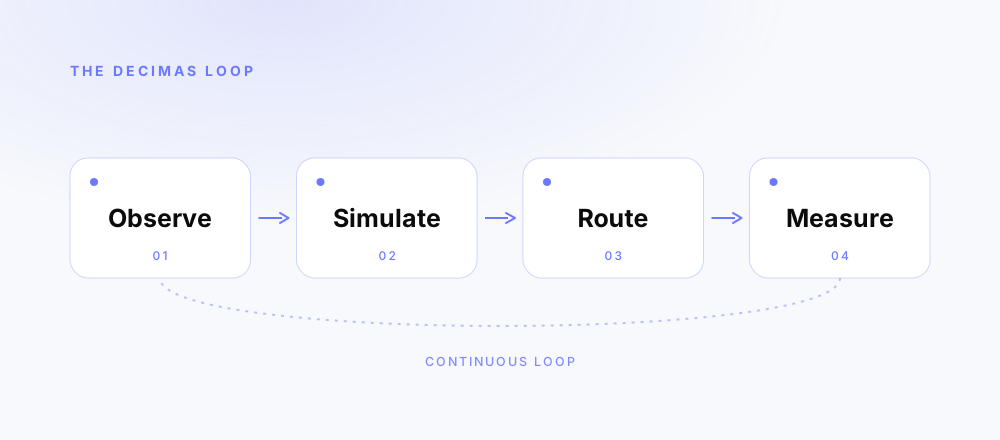
Decimas exécute la même boucle en quatre étapes à chaque cycle, qu'il se déclenche une fois par minute ou des milliers de fois par seconde.
- Observer le marché — ingérer le carnet d'ordres, les transactions et les positions dans un snapshot unique et cohérent.
- Simuler les résultats — faire tourner les stratégies candidates sur ce snapshot, en incluant les fills, le slippage et l'impact.
- Acheminer l'exécution — traduire le plan retenu en ordres et les envoyer via la couche venue.
- Mesurer le risque — évaluer la position résultante, la réinjecter et conditionner le cycle suivant.
La boucle se referme sur elle-même. Le risque mesuré en fin de cycle devient une contrainte sur la simulation au début du suivant, de sorte que le système resserre ou assouplit son propre comportement à mesure que les conditions évoluent.
La simulation est le produit, pas un accessoire
Dans la plupart des stacks, la simulation est quelque chose que l'on fait en amont, dans un notebook, sur les données de la semaine passée. Dans Decimas, elle s'exécute à l'intérieur de la boucle live, sur le snapshot courant, dans le même budget que la production. La question n'est jamais seulement « qu'a fait cette stratégie en backtest » mais « que va faire cet ordre sur ce carnet, maintenant, compte tenu de ce que je détiens ».
C'est ce qui en fait une plateforme de trading quantitatif plutôt qu'une bibliothèque de stratégies. Les stratégies d'exécution, l'intelligence de portefeuille et le risque ne sont pas des produits séparés assemblés ensemble — ce sont des vues sur un état simulé unique. Une contrainte de portefeuille et une tactique d'exécution s'appuient sur le même modèle du marché, et ne peuvent donc pas diverger silencieusement.
Les algorithmes de trading par apprentissage automatique y vivent aussi, en tant que politiques. Un modèle propose ; la couche de politique décide si la proposition est autorisée. Les limites de position, les plafonds d'exposition et les règles de venue sont appliqués au moment où l'ordre se forme, et non découverts après son exécution. Un ordre rapide mais erroné reste un ordre erroné, aussi les contrôles de correction sont-ils embarqués avec la vitesse.
Une vitesse que vous pouvez défendre
Le cœur accéléré par Mojo existe pour que la boucle tienne dans son budget sans appauvrir le raisonnement qu'elle contient. La vitesse n'est pas le but ; c'est l'espace qui permet à la simulation et aux contrôles de risque de rester suffisamment riches pour être fiables. L'intérêt d'un système de trading algorithmique par IA n'est pas d'agir avant tout le monde — c'est d'agir sur une décision que vous pouvez assumer.
Decimas est déterministe par conception, et c'est ce déterminisme qui rend le rejeu possible. À snapshot et politiques identiques, le runtime produit les mêmes ordres, à chaque fois. Quand quelque chose se comporte étrangement en production, vous ne le reconstituez pas à partir de logs et de suppositions. Vous rejouez le cycle exact et observez la décision se former.
Pour un desk de trading, cela comble une lacune que la plupart des logiciels de trading algorithmique laissent ouverte. L'audit cesse d'être une reconstruction pour devenir un enregistrement. Une question de conformité, une revue de risque, un post-mortem sur un mauvais fill — chacun se résout au même artefact : le cycle, rejoué, identique.
La suite
Plus les marchés se durcissent, plus l'avantage se déplace d'un modèle plus rapide vers une décision plus rapide et traçable. Une plateforme de trading quantitatif capable de simuler, d'acheminer et de rejouer dans un seul budget transforme la latence d'une taxe en paramètre de conception — quelque chose que l'on dépense délibérément plutôt que l'on perd par inadvertance. Decimas est conçu pour les desks qui préfèrent savoir exactement ce qu'ils ont fait plutôt que deviner vite. À mesure que les modèles gagnent en capacité, la contrainte qui compte le plus reste l'horloge, et la discipline reste la même : observer, simuler, acheminer, mesurer — et pouvoir le prouver.